AirOps Review 2026: A Content Engine for AI Search, Not a Visibility Tracker
AirOps gets lumped in with AI visibility tools, and that is the wrong shelf. It is a content production platform that happens to measure AI search. This review covers what it actually does, what it costs in September 2026, and who should buy it. Disclosure: Mavek competes with parts of it.
AirOps is an AI content engineering platform for SEO and growth teams. It lets you build workflows that research, draft, refresh and publish content at scale, grounded in your own data, and since 2025 it adds AI search insights and an agent called Quill that keeps pages visible in answer engines. On September 2, 2026 it went a step further, formally adding a services arm that sets and runs AI search strategy with you. It remains sales-led with no published list price as of late September 2026.

What AirOps Is
AirOps was founded in early 2022 by Alex Halliday, its CEO, with Matt Hammel and Berna Gonzales. It started as a workflow builder for marketers who wanted to chain language models, data sources and integrations into repeatable content pipelines. The company raised a $7 million seed led by Wing VC, a $15.5 million Series A led by Unusual Ventures in October 2024, and a $40 million Series B led by Greylock in November 2025, which Fortune reported at a $225 million valuation. Customers named on its site include Upwork, Ramp, Webflow, Chime and Carta.
In 2025 the positioning shifted from "content at scale" to "win AI discovery". The workflows are the same; the goal is now to produce and maintain content that answer engines cite. On May 13, 2026, AirOps launched Quill, described as an AI agent that monitors a brand's visibility, decides which pages need updating, and drafts the changes.
Then, on September 2, 2026, founder Alex Halliday announced what the company calls its next chapter: an expansion from software into a partner model, pairing the platform with a team of channel experts who set and execute AI search strategy across owned content, third-party placements, community, social, and emerging AI ad surfaces. The announcement leans on scale claims (6 billion citations, 1.5 billion prompts in its dataset) and case results for Airbnb Experiences Paris, Chime and LegalZoom. Read plainly, AirOps is no longer selling only a builder; it is selling the outcome, with people attached. By late September its own platform pages have stopped using the Quill name, folding that monitor-and-refresh loop into a broader intelligence, action and measurement story.
What It Does
Three layers. The first is the workflow builder, where you assemble steps: pull search data, research a topic, draft against a brand kit, check it against a knowledge base, push it to a CMS. Grids let you run a workflow across hundreds of rows, which is how teams produce programmatic pages or refresh an entire category. Integrations cover the major CMSs (Webflow and WordPress among them), SEO data providers, and project tools.
The second layer is knowledge. Brand kits hold voice and positioning; knowledge bases hold the documents, product data and past content the workflows draw on. This is what keeps the output specific rather than generic, and it is where most of the setup time goes.
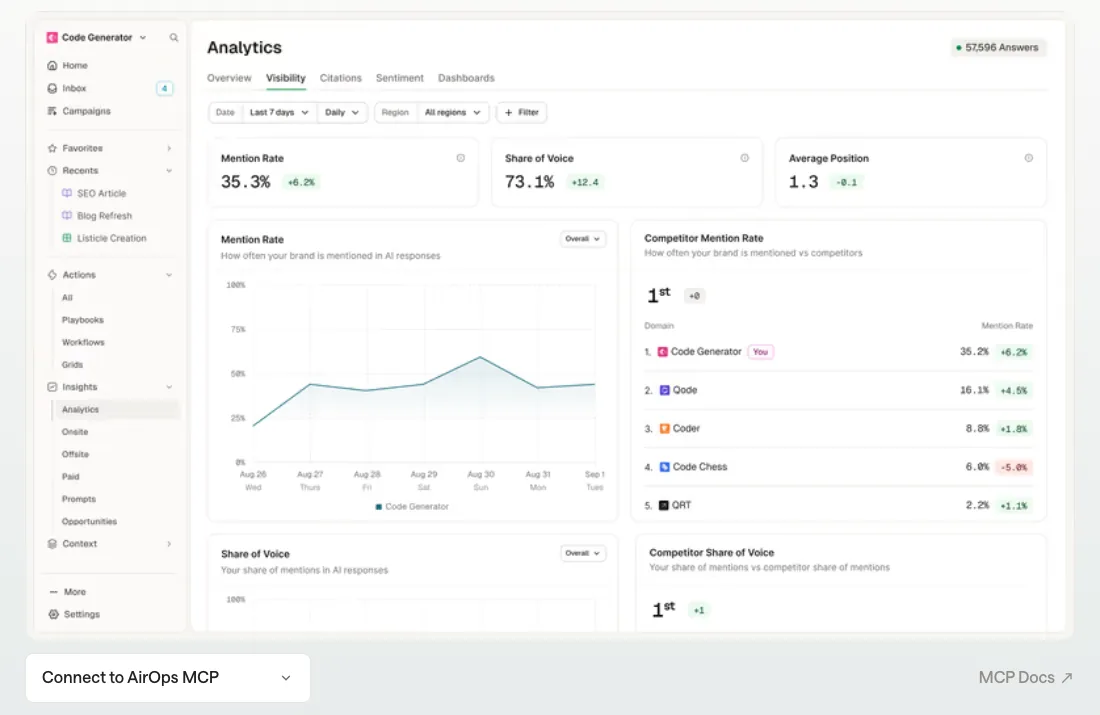
The third layer is insights. Solo tracks ChatGPT; Pro and above track seven or more answer engines. It shows where you are mentioned and cited so the workflows can target the gaps. Quill sits on top: it watches the insights, flags decaying or missing pages, and drafts updates for review. It is the piece that makes AirOps an answer engine optimization product rather than a writing tool.
AirOps Pricing (September 2026)
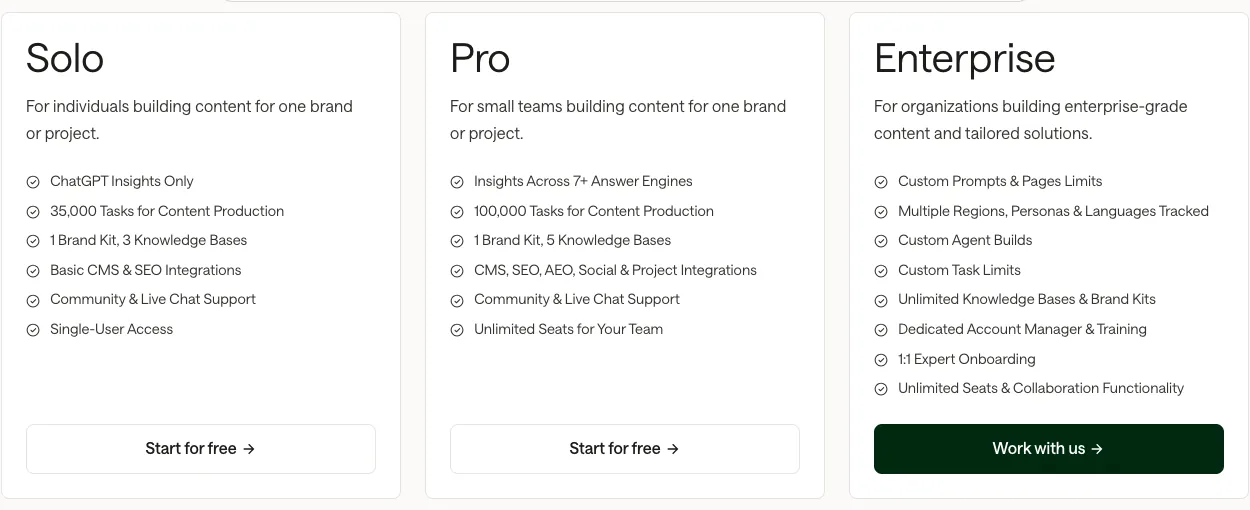
The pricing page lists three plans. The two self-serve tiers are labelled free to start, and neither shows a monthly list price. A 14-day trial is offered with no payment required. Usage is metered in tasks. What a task costs beyond the included allowance, and what a paid seat costs at all, is not published, so the table below is what we could verify.
| Plan | Price | Includes | Best for |
|---|---|---|---|
| Solo | Free to start, list price not published | ChatGPT insights only, 35,000 content tasks, 1 brand kit, 3 knowledge bases, basic CMS and SEO integrations, single user | One person testing the workflow builder |
| Pro | Free to start, list price not published | Insights across 7+ answer engines, 100,000 content tasks, 5 knowledge bases, CMS, SEO, AEO, social and project integrations, unlimited seats | Content and SEO teams producing at volume |
| Enterprise | Custom | Custom prompt and page limits, multiple regions and personas, custom agent builds, unlimited knowledge bases and brand kits, account manager, 1:1 onboarding | Large brands with a dedicated content operation |
In practice AirOps sells consultatively. The named customers are large, the enterprise plan includes an account manager and one-to-one onboarding, and the homepage describes staying "hands-on from setting strategy through execution". Since the September services expansion, the primary call to action across the site is "Work with us". Expect an annual contract and a sales conversation if you want the full product.
Where AirOps Is Strong
- Production at scale. If you need to create or refresh hundreds of pages with consistent voice and real data behind them, the grid-plus-workflow model is the most mature we have seen.
- Grounding. Knowledge bases and brand kits do real work. Output from a well-configured AirOps account is noticeably more specific than a raw language model draft.
- CMS integrations. Publishing is part of the workflow, not a copy-paste step.
- Quill closes the loop. Monitoring that leads to a drafted change is more useful than monitoring that leads to a spreadsheet.
- Free tier and 14-day trial. You can build a workflow before you talk to anyone.
Where It Falls Short
- Not a visibility tracker. The insights layer is there to feed the workflows. If you want citation-level analytics, sentiment tracking across nine engines, or crawler analytics, Profound and Scrunch do it better and Peec does it cheaper.
- No published price. You cannot budget for AirOps from its website. For a founder deciding between four tools, that is a real cost.
- Setup burden. The grounding that makes the output good takes weeks to configure well. A team of one will not get there.
- Content only, in the software. The platform does not run Google or Meta ads, manage outreach, or track classic keyword rankings. The September 2026 services expansion adds external placements, community, social and emerging AI ad surfaces, but through AirOps's team on a custom engagement, not as self-serve product.
- Volume temptation. A tool that can publish 500 pages will let you publish 500 bad pages. The platform is not the guardrail; your editors are.
Who Should Buy It
AirOps fits a content or SEO team of three or more with a large site, a real backlog of pages to produce or refresh, and the budget for an annual contract. It fits especially well when someone on the team enjoys building systems. It is a poor fit for a founder who needs marketing done rather than a machine to build, and for anyone whose primary question is "does ChatGPT mention us", which a tracker answers faster and cheaper.
AirOps vs Mavek
We build Mavek, so read this section knowing that. The overlap grew in September 2026: with the services expansion, AirOps now also sells a platform with people attached. The difference is who each one is built for, and what you pay to find out. AirOps is enterprise-shaped: sales-led, priced on conversation, deepest when a team of three or more runs its AI search workflows or commissions its channel experts. Mavek is founder-shaped: the platform drafts and publishes SEO content, runs technical SEO, a rank tracker and Google and Meta ads, tracks AI visibility across five answer engines, and a human team reviews the plan, at published prices from $125 a month.
| AirOps | Mavek | |
|---|---|---|
| What it is | Content engineering platform, plus a services arm since September 2026 | AI marketing platform with a human review layer |
| Pricing | Free to start, no published list price, sales-led contracts | Published, from $125 a month |
| Content production | Workflow builder, grids, knowledge bases; built for programmatic scale | Drafting and WordPress publishing; built for a steady page cadence, not thousand-page runs |
| Beyond content | External placements, community, social and AI ads via the services team | Google and Meta ads, rank tracking and technical SEO in the product |
| AI visibility | Insights across 7+ engines on Pro; ChatGPT only on Solo | Tracker for ChatGPT, Claude, Gemini, Perplexity and Google AI Overviews, refreshed weekly |
| Best for | Content and SEO teams of three or more with a large site and enterprise budget | Founders and lean teams who want the work done and checked |
The buying logic: if you will run the machine, or pay AirOps's team to run it with you, and your site is big enough to justify it, AirOps is the deeper system. If what you actually want is the month's marketing work done, reviewed, and billed at a number you saw before the call, that is the job Mavek is built for. The budgets rarely compete, so this is less a versus than a fork in company stage.
AirOps Alternatives
Profound for enterprise AI visibility analytics with its own content agents. See Mavek vs Profound.
Peec AI for affordable daily tracking, from about $95 a month. Our Peec AI review has the detail.
Scrunch AI for tracking plus a delivery layer that serves AI crawlers a readable version of your site. See our Scrunch AI review.
Jasper if the job is brand-consistent writing rather than workflow engineering; our Mavek vs Jasper page covers that trade.
Mavek is our own product, compared honestly in the section above: it trades AirOps's workflow depth for done-and-checked execution at a published price. The rest of the field is in our roundup of the best AI visibility tools.
Verdict
AirOps is a serious content engineering platform that has correctly aimed itself at AI search. Judge it as that, not as a tracker. If you have the team to run it and the pages to justify it, it is among the best tools of its kind. If you do not, the trial will show you a powerful builder and a long road to results.
Frequently Asked Questions
What is AirOps?
AirOps is a content engineering platform for SEO, content and growth teams. It lets you build AI workflows that research, draft, refresh and publish content at scale, grounded in your own knowledge bases and brand kits, with integrations into CMSs like Webflow and WordPress. Since 2025 it has added AI search insights that show how brands appear in ChatGPT and other answer engines, and in May 2026 it launched Quill, an agent that monitors and updates content for AI visibility.
How much does AirOps cost?
As of September 2026, AirOps's pricing page shows Solo and Pro plans labelled free to start, with no published monthly list price, and a custom-priced Enterprise plan. A 14-day free trial is offered with no payment required. Usage is metered in tasks (35,000 on Solo, 100,000 on Pro). For an actual number you will need to start the trial or talk to sales.
Who founded AirOps?
AirOps was founded in early 2022 by Alex Halliday, who is CEO, with co-founders Matt Hammel and Berna Gonzales, who is CTO. The company is based in New York and San Francisco.
How much funding has AirOps raised?
AirOps raised a $7 million seed led by Wing VC in 2023, a $15.5 million Series A led by Unusual Ventures in October 2024, and a $40 million Series B led by Greylock in November 2025 at a reported $225 million valuation. Some analyst sites list a further 2026 round, but AirOps has not announced one, so we do not count it.
Is AirOps an AI visibility tool?
Not primarily. AirOps is a content production platform first. It includes AI search insights, and Quill monitors visibility to decide what content to refresh, but if you want pure multi-engine tracking with citation analytics, Profound, Peec AI or Scrunch AI are built for that job and AirOps is not.
Can AirOps's Quill use our brand kit to enforce tone and style across thousands of drafts?
That is the design. Brand kits are AirOps's mechanism for voice, style and positioning rules, and workflow output, including the updates Quill drafts, is grounded in the brand kits and knowledge bases you configure. Two caveats from our review: the grounding is only as good as the setup time you invest, and AirOps itself routes drafted changes through human review rather than publishing thousands of edits unattended. Note that by late September 2026 the Quill name has been folded into AirOps's broader platform story.
Can Quill be configured to only suggest edits below a set severity threshold?
AirOps has not publicly documented a severity-threshold control for Quill. The published workflow is monitor, flag, draft, then human review, and that review step is where gating happens as of September 2026. If edit-severity gating is a hard requirement, put it to AirOps on a demo and treat any yes as roadmap until it appears in the docs.
What are the best AirOps alternatives?
For content workflows at scale, Jasper and general-purpose agent builders overlap with AirOps. For AI visibility tracking, Profound, Peec AI and Scrunch AI. For a lean team that wants tracking, SEO execution, content and ads with a human team in one platform at a published price, Mavek is an option, with the disclosure that it is our product.
AirOps vs Mavek: which should you pick?
Pick AirOps if you have a content or SEO team of three or more, a large site, and the budget for a sales-led annual contract: its workflow builder, grids and knowledge bases are the deepest content engineering stack we have reviewed, and since September 2026 its services team will run the strategy with you. Pick Mavek if you are a founder or lean team that wants the SEO, content and ads work done and checked at a published price, from $125 a month, with weekly AI visibility tracking across ChatGPT, Claude, Gemini, Perplexity and Google AI Overviews. AirOps is a system you operate or commission; Mavek is work that arrives reviewed.