ChatGPT Query Fan-Out: Answer the Questions Behind the Prompt
I asked ChatGPT "what is the best ai tool for aeo". Mavek is an AEO tool. It was not on the list. This is the workflow I used to find the questions ChatGPT was really answering, and to put my own answers to them on the site.
What ChatGPT Query Fan-Out Is
When you type a prompt into ChatGPT with search on, it does not run that prompt as one search. It rewrites it into several narrower sub-queries, searches for each, and writes the answer from the pages those searches return. That is query fan-out.
"Best AI tool for AEO" quietly becomes questions about pricing, how tracking works, which metrics matter and how the tools compare. Google does the same for AI Overviews and AI Mode, and says so in its own documentation.
The consequence is simple. The answer is built from the sub-questions, so the pages that get cited are the ones that answer the sub-questions. If your site only talks about the head term, there is nothing for the engine to pick up. The theory of how this works is further down. First, the workflow.
The Workflow, Step by Step
1Pick a prompt you do not show up for
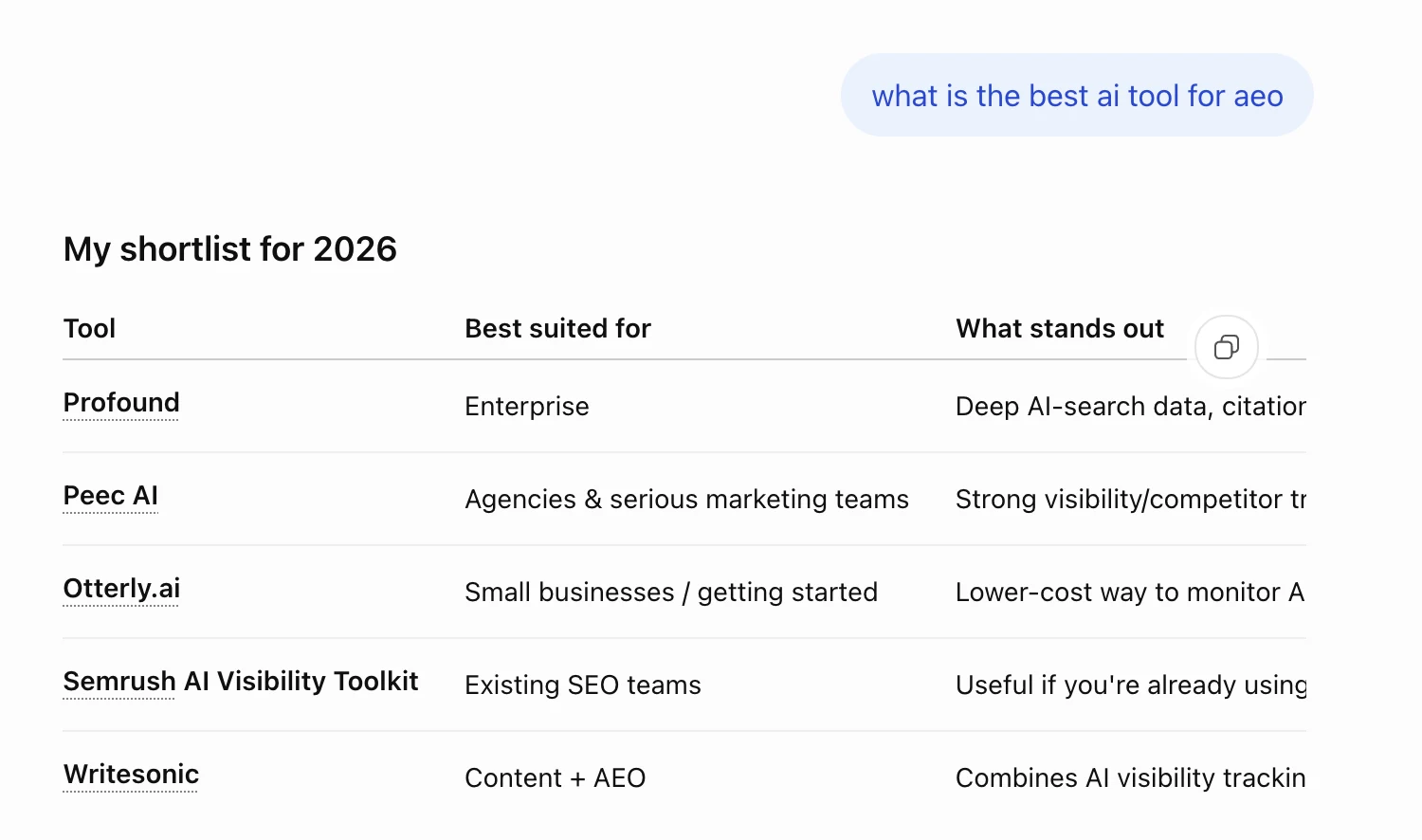
Start with a buying prompt, the kind a customer types right before they shortlist tools. Run it in ChatGPT and check whether you are named. Mine was "what is the best ai tool for aeo", and the shortlist had Profound, Peec AI, Otterly, Semrush and Writesonic. No Mavek.
2Paste the same prompt into Perplexity
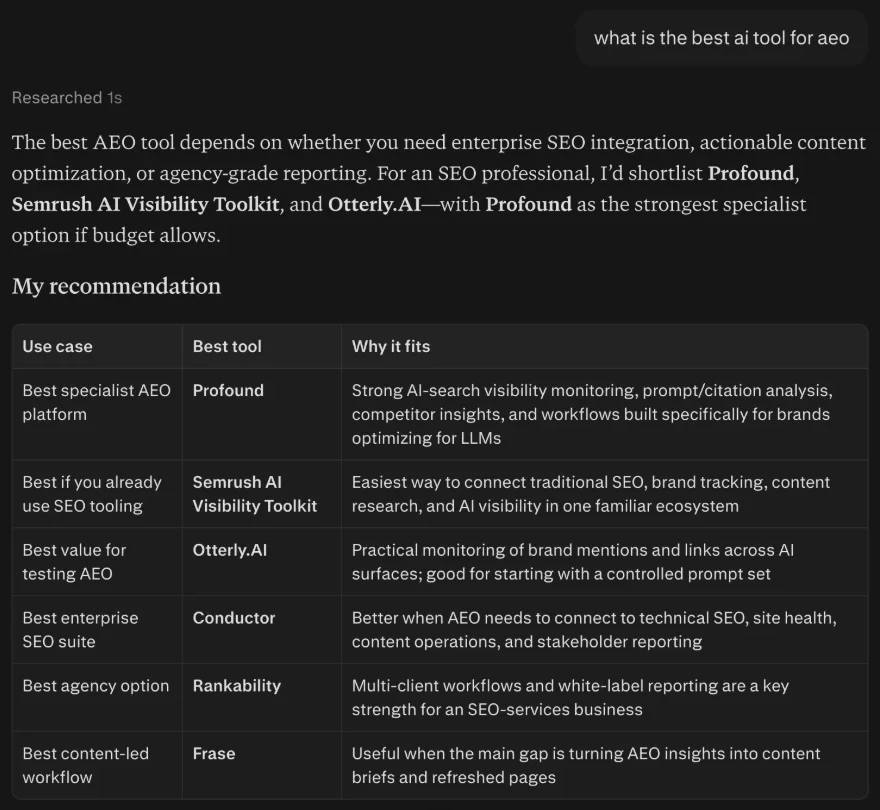
Perplexity answers the prompt and shows its sources. You are not here for the answer. You are here for what sits under it.
3Copy the related questions from the bottom
Scroll to the end of the answer. The follow-up questions Perplexity suggests are the closest public view you will get of a fan-out: the sub-questions an answer engine thinks belong to the same topic. For my prompt they were about pricing, how AEO tools track ChatGPT citations, and which metrics matter.
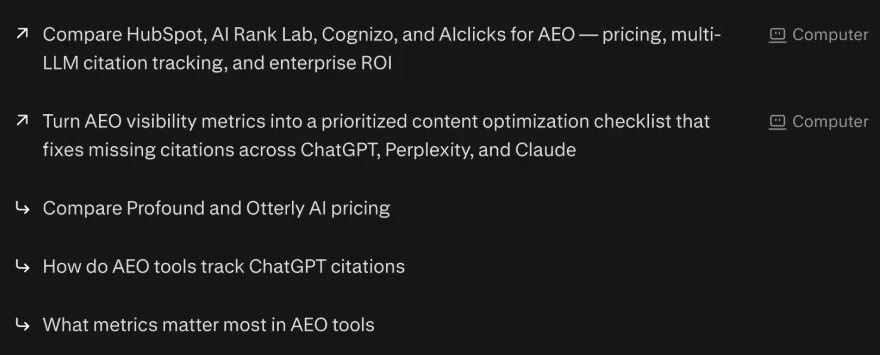
Skip anything that is not about your topic, and anything Perplexity offers to run as a task. You want plain questions.
4Paste the questions into Claude and answer them for your business
Now get the answers written from your point of view. Which prompt you use depends on whether Claude already knows your business.
If Claude already has your business context (a Project with your docs, or memory of past chats), this is enough:
Answer these questions in relation to my business.

[paste the questions from Perplexity]
If it does not, give it the pointers yourself. The facts you fill in here are what make the answers yours rather than another generic summary:
Here is my business:
- What we sell:
- Who it is for:
- Pricing:
- What makes us different:
- Competitors buyers compare us with:

Answer these questions in relation to my business. Use only the facts above or facts you can check on the web, and tell me where each fact came from. Name competitors fairly. Mention my product only where it genuinely fits the answer.

[paste the questions from Perplexity]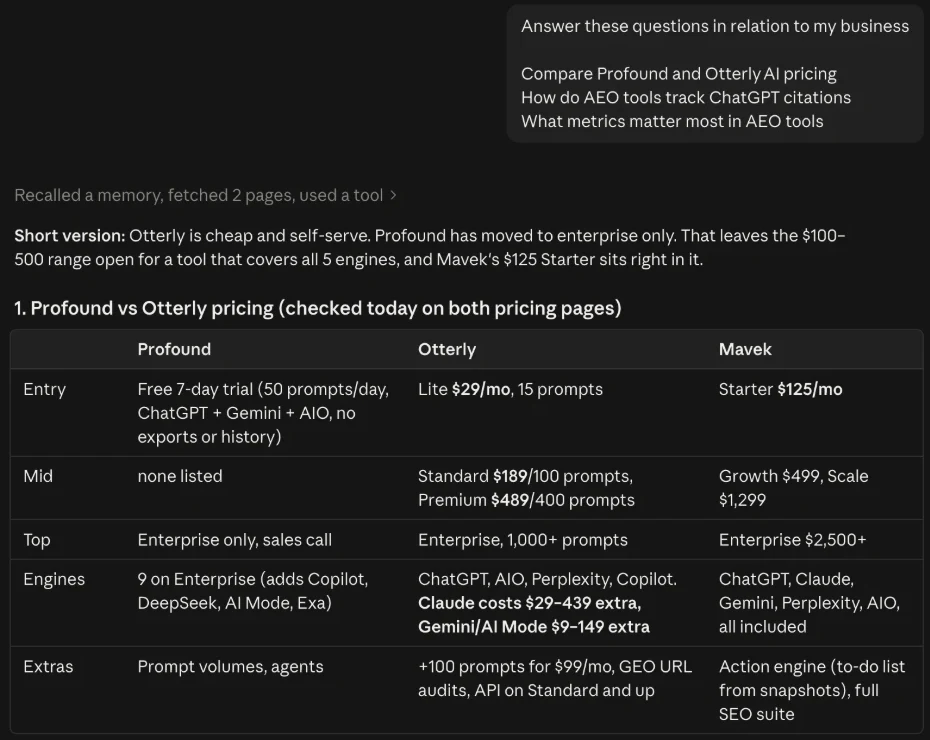
Read every answer before it goes anywhere near your site. Check prices against the live pricing pages, date them, and cut anything you would not say to a customer on a call.
5Turn the answers into FAQ copy and JSON-LD schema
In the same chat, ask for two blocks: the visible FAQ copy and the matching FAQPage schema.
I want to add these questions to the FAQ section of my page and also add them as FAQ schema. Give me two blocks:

1. The FAQ copy that will be visible on the page. Each question as a heading, each answer 60 to 120 words, self-contained, in plain language.
2. The JSON-LD FAQPage schema for the same questions and answers, matching block 1 word for word, inside a <script type="application/ld+json"> tag.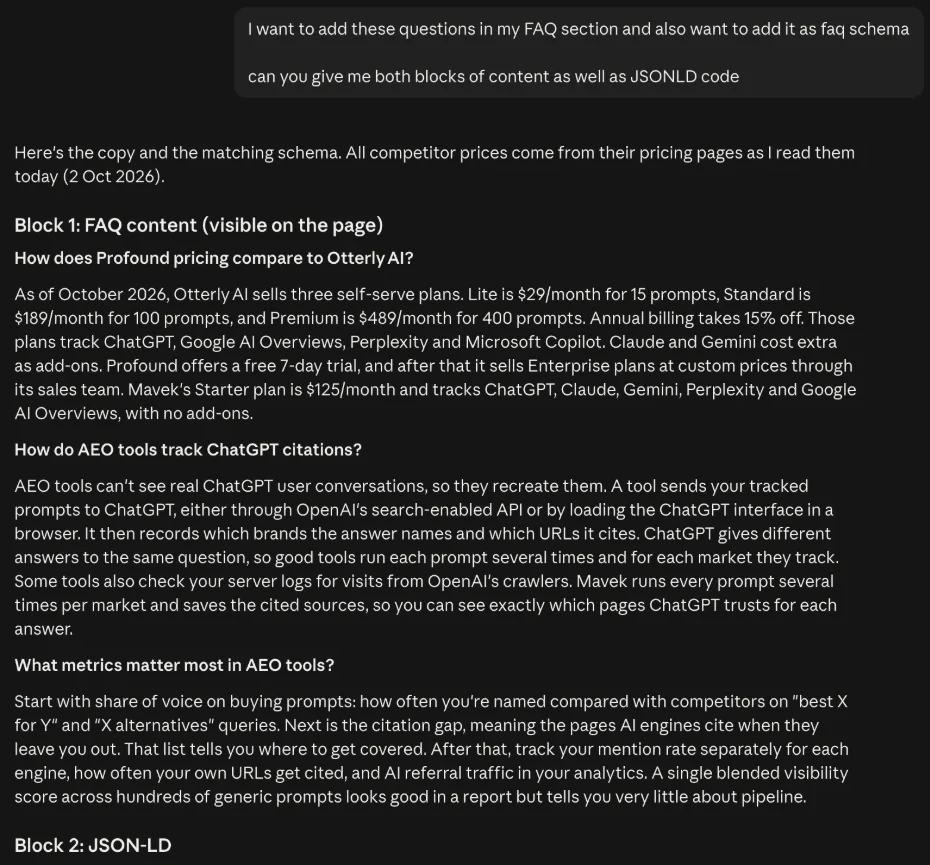
Paste the JSON-LD into Google's Rich Results Test (choose Code) before you publish, so a missing comma does not break it silently.
6Upload it to your website
Put the FAQ section on the page that best matches the prompt. For a "best tool" prompt that is usually your pricing, comparison or alternatives page, not the homepage. The copy has to be visible on the page; schema describing text nobody can see is a guideline violation, not a shortcut. Add the JSON-LD to the same page.
Then get it crawled. Request indexing for the URL in Google Search Console, and submit it through IndexNow so Bing picks it up quickly, which matters because ChatGPT search leans on Bing's index. Our IndexNow guide has a free submitter.
7Track the prompt to see if it worked
This is the step almost everyone skips. AI answers change from run to run, so checking the prompt once in ChatGPT tells you nothing. You need the same prompt run repeatedly, across engines, with the cited pages saved, so you can see whether your page starts showing up.
That is what Mavek's AI visibility tracking does. Add the prompt you started with, and Mavek runs it on ChatGPT, Claude, Gemini, Perplexity and Google AI Overviews, records whether you are named, and shows which pages each engine cited instead of yours.
Track your prompt in Mavek. Add the prompt from step 1 and see, engine by engine, whether your new FAQ section changes who gets cited.
Start Free TrialWhat This Does, and What It Does Not
Being honest about the mechanics, because this workflow gets oversold.
- It covers the fan-out. Your site now has passages that answer the sub-questions an engine runs, which it did not before.
- It makes those passages easy to lift. A question as the heading with a direct answer below is a self-contained chunk, which is how AI engines retrieve and quote text.
- It ties your brand to the topic. Your product now appears in the same passages as the category terms, on your own domain.
- The schema is labelling, not a lever. Google stopped showing FAQ rich results for most sites in 2023, and there is no published evidence that AI engines reward FAQPage markup. It does no harm. It is not why this works.
- It does not make you the consensus. For "best X" prompts, engines lean heavily on what other sites say: comparison posts, review sites, forums. Your own FAQ gets you into the pool of sources. Getting named by others is the next job.
The Theory: How Query Fan-Out Works
The workflow above is the practical half. This is the reasoning behind it, so you can apply it to prompts and engines this post does not cover.
Where the term comes from
"Query fan-out" became a mainstream term when Google introduced AI Mode in 2025 and described it as the technique behind the feature: break a question into subtopics, issue many searches at once, and combine what comes back. Google's Search Central documentation now says AI Overviews and AI Mode may both use it. The idea is older than the name. Search engines have rewritten and expanded queries for decades; what changed is that a language model now does the rewriting, and it writes far more varied sub-queries than a synonym list ever could.
The four stages of a fan-out
What happens between your prompt and the answer
- 1DecomposeThe model reads the prompt and decides what someone asking it would need to know: definitions, comparisons, prices, how-tos, named products.
- 2Search in parallelEach sub-query goes to a search index on its own. ChatGPT search leans heavily on Bing's index plus OpenAI's own crawler; Google uses its own index.
- 3Select passagesFrom the returned pages, the system pulls the specific chunks of text that answer each sub-query best. Whole pages are not used; passages are.
- 4Synthesise and citeThe model writes one answer from those passages and cites the pages they came from.
Every stage changes what you should publish. Stage 1 decides which questions exist. Stage 2 decides whether your page is even in the pool, which is why ordinary indexing and ranking still matter. Stage 3 decides whether a specific paragraph of yours is the best answer to a specific sub-question. Stage 4 decides whether your name survives into the final text.
Why a long-tail answer can beat a head-term ranking
Sub-queries are narrower than the prompt. "Compare Profound and Otterly AI pricing" has far fewer strong pages competing for it than "best AI tool for AEO". A page that would never reach the first page of results for the head term can be the single best result for one sub-query, and that is enough to be cited in the final answer.
This flips the usual priority. In classic SEO you fight for the head term and pick up the long tail along the way. With fan-out, the long tail is where you get into the answer, and the head term is the prompt you measure yourself against.
Why passages beat pages
Because selection happens at the passage level, how a page is written matters as much as what it covers. A passage gets chosen when it can stand alone: the question is clear from the heading, the answer comes in the first sentence or two, and the paragraph does not lean on context from elsewhere on the page. A 3,000-word essay that answers six questions in one flowing argument gives the system nothing clean to lift. The same information as six headed answers gives it six chances.
This is the real reason an FAQ section works in this workflow. It is not the schema. It is that a question-and-answer block is the most liftable passage format there is.
Why the fan-out is never the same twice
The sub-queries are generated fresh on each run. The same prompt can fan out differently depending on the wording, the user's location, the conversation so far, memory, and plain randomness in the model. Two people asking the same question can get different sources.
Two practical consequences. You cannot reverse-engineer the exact queries, so aim to cover the topic's natural sub-questions rather than chase one list. And you cannot judge a change from one check. Visibility in AI answers is a rate (how often you are named across many runs), not a position.
What the engine needs to name you
Being in a cited passage is not the same as being recommended. For the model to name your product in the answer, it has to understand what your product is and see it described the same way in more than one place. Three things help:
- Clear entity description. Your own pages should say plainly what the product is, who it is for and what it costs, in words that match how buyers ask.
- Corroboration. Comparison articles, review sites and community threads that describe you the same way. For "best X" prompts this is often the deciding factor.
- Freshness. Engines favour current information for anything involving prices or rankings. Date your facts and update them when they change.
How fan-out changes keyword research
Keyword research used to start with a list of terms and their volumes. For AI search, start with the prompts your buyers type, then map the sub-questions each prompt fans out into. Many of those sub-questions have little or no measurable search volume, because people rarely type them into Google; the AI asks them on the user's behalf. A keyword tool will undervalue exactly the questions that decide AI answers. Group what you find by intent the same way you would cluster keywords; our keyword clustering prompt works for sub-questions too.
Frequently Asked Questions
What is ChatGPT query fan-out?
Query fan-out is what ChatGPT search does before it answers you. Instead of running your prompt as one search, it rewrites it into several narrower sub-queries, searches for each, and builds the answer from the pages those searches return. Google uses the same technique for AI Overviews and AI Mode and documents it in Search Central.
How many sub-queries does ChatGPT run for one prompt?
OpenAI does not publish a number, and it varies. Simple factual prompts may need one search, while comparison and recommendation prompts tend to fan out into several. The count and wording change between runs, which is why covering a topic's natural sub-questions works better than chasing one list.
Is query fan-out the same as keyword research?
No, but they connect. Keyword research measures what people type into a search engine. Fan-out sub-queries are written by the AI on the user's behalf, so many have little or no search volume in keyword tools. Start from the buyer's prompt, map the sub-questions it fans out into, then cluster them by intent the way you would keywords.
Does query fan-out apply to Google AI Overviews and Perplexity too?
Yes. Google documents fan-out for AI Overviews and AI Mode. Perplexity also runs multiple searches for complex questions and shows the follow-up questions it associates with a topic. The workflow in this guide works for all three, because each one builds answers from passages that match sub-questions.
Why does query fan-out matter for getting cited by ChatGPT?
Because the answer is assembled from the sub-queries, not just the prompt you typed. A page can be cited for answering one sub-question well even if it never ranks for the main question. If none of your pages answer the sub-questions, there is nothing for the engine to pull from, however good your homepage is.
Can I see the exact fan-out queries ChatGPT runs?
Not reliably. The sub-queries are generated on the fly and change between runs. The related questions Perplexity shows under an answer are a practical stand-in: they are the follow-ups an answer engine thinks belong to the same topic, which is close to what a fan-out covers.
Does FAQ schema make ChatGPT recommend my website?
Not on its own. FAQ schema makes your questions and answers machine-readable, but since 2023 Google only shows FAQ rich results for a small set of authoritative government and health sites, and there is no published evidence that AI engines rank pages higher for having it. The visible answers on the page do the work. Treat the schema as clean labelling, not a ranking lever.
How long before a new FAQ section shows up in AI answers?
There is no fixed timeline. The page has to be crawled and indexed first, which you can speed up by requesting indexing in Search Console and submitting the URL through IndexNow for Bing. After that, answers vary from run to run, so judge the change over a few weeks of repeated checks rather than a single prompt.
Should I copy Perplexity's answers onto my page?
No. Copied answers add nothing an engine does not already have, and they rarely mention your business. Use Perplexity only to find the questions. Write the answers from your own facts, pricing and experience, which is the part no other page can supply.