What Is Conversational Search? How ChatGPT, Perplexity and Google AI Mode Pick Who Gets Named
Conversational search is a way of searching where you ask a question in plain language, get one written answer, and keep asking follow-ups that remember what you already said. ChatGPT search, Perplexity, Google AI Mode, Gemini, Claude and Microsoft Copilot all work this way. Instead of ten blue links, they return a short answer that names a few sources and a few brands.
For a marketer, that changes the question from "where do we rank?" to "do we get named?". Google says the average AI Mode search is three times the length of a traditional Google query, and AI Mode passed one billion monthly users in May 2026. Longer questions carry budget, team size and location, so the shortlist an engine gives a 10-person startup in Austin is not the one it gives an enterprise team in London.
For a startup selling into the US or UK, the pages ChatGPT, Perplexity and AI Mode read for those longer questions now decide which brands make the shortlist. Below: how those engines pick names, what a follow-up does, and what to change on your site.
What Is a Conversational Search Engine?
A conversational search engine is a search tool that answers in sentences and keeps the context of the whole chat. The best known are ChatGPT search (OpenAI), Perplexity, Google AI Mode, Gemini (Google), Claude (Anthropic) and Microsoft Copilot. Each one searches the web, reads a handful of pages and writes an answer with citations.
The term has a second meaning. Algolia, Coveo, Zoovu and AddSearch sell "conversational search" as the search box on your own website. A shopper types "waterproof boots under $150 for wide feet" and gets matching products. Most of Google's page one for "conversational search engine" is this site-search meaning.
This guide covers the first meaning: ChatGPT, Perplexity, AI Mode and the other public engines that decide whether your brand appears when a buyer asks about your category. If you run a Shopify catalogue, Algolia and Coveo are worth a separate look.
How Is Conversational Search Different From Keyword Search?
Conversational search in ChatGPT or Perplexity differs from keyword search on classic Google in four ways: the length of the question, the memory between questions, the format of the result, and what gets credit.
| Keyword search (classic Google) | Conversational search (ChatGPT, Perplexity, AI Mode) | |
|---|---|---|
| Query | 2 to 4 words, "crm for startups" | A full sentence or paragraph with constraints |
| Follow-ups | Each search starts from zero | The engine remembers earlier turns |
| Result | 10 ranked links | One written answer citing a few sources |
| Who gets credit | Pages, ranked by position | Brands and passages, named or not named |
The practical result is that ranking #4 on Google and being absent from the ChatGPT answer can happen at the same time. Rank tracking in Ahrefs or Semrush still matters, but it no longer tells you the whole story.
How Does Conversational Search Decide Which Brands to Name?
Conversational search engines such as ChatGPT and Perplexity name brands that show up in the pages they read for the question and in the wider web around it. Three mechanics do most of the work.
Query fan-out. ChatGPT search and Google AI Mode split one prompt into several narrower searches, then build the answer from what those searches return. Google documents this for AI Mode. A page can be cited for answering one sub-question well even if it never ranks for the main question. We walk through finding those sub-questions in our ChatGPT query fan-out guide.
Where the answer sits on the page. Kevin Indig's analysis of 18,012 ChatGPT citations found 44.2% came from the first 30% of the page. ChatGPT quoted sentences that were definitive ("X is..."), named specific tools and people, and were written plainly. A page that saves its answer for paragraph twelve is far less likely to be quoted. The study covers ChatGPT only, so treat it as a strong guide for other engines, not proof.
Mentions beyond your site. Ahrefs studied 75,000 brands and found branded web mentions had a 0.664 correlation with visibility in Google AI Overviews, against 0.218 for backlinks. Reviews on G2, threads on Reddit, YouTube videos and listicles on other sites all count. It is a correlation, but it explains why a brand with weak SEO can still get named.
What Does a Follow-Up Question Do to Your Visibility?
A follow-up question narrows the answer, and the brands ChatGPT or Perplexity name on the second turn are often not the ones they named on the first.
We ran this test on Mavek on 4 October 2026, in a ChatGPT temporary chat. Turn one asked for "the best tool to track whether ChatGPT and other AI search engines mention my brand". ChatGPT named Profound, Peec AI, Otterly.AI, Semrush and Ahrefs. Mavek was not on the list.
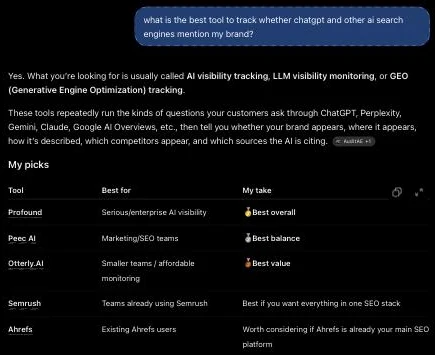
Turn two added the constraints a startup buyer actually has: "we're a 10-person startup, budget under $150 a month, and I want one tool that tracks AI visibility and also does the SEO and content work". The shortlist changed. SE Ranking moved to first, Semrush second and Frase third. Profound and Ahrefs dropped out, and Peec AI fell to fourth because it "doesn't really do the SEO work".
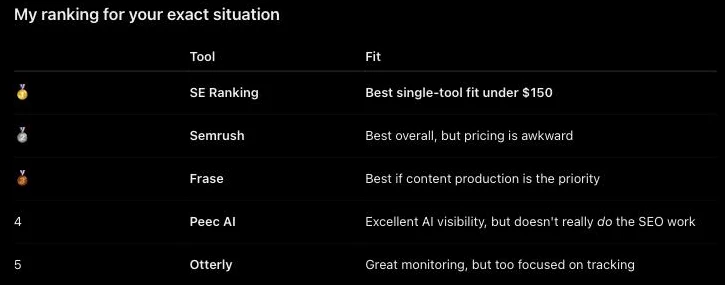
Mavek was missing on both turns, even though turn two describes what Mavek sells. That is the gap this kind of test shows. ChatGPT found nothing that tied Mavek to "under $150, tracking plus SEO work for a small team", so it named the tools whose pages and reviews say so. One run is a snapshot, since answers change between runs, but the direction is clear enough to act on.
You can run the same test in ten minutes. Ask ChatGPT or Perplexity your category's buying question and note who is named. Then add the constraint your best customers always mention: price, team size, industry, country or an integration such as HubSpot or Shopify. If your brand appears only after the constraint, your site is doing its job for that niche. If it never appears, the engines have nothing that answers the narrower question.
This is why pages for specific situations, such as pricing, "for startups" pages and honest comparison pages, matter more in conversational search than they did for a 3-word keyword.
How Do You Optimize for Conversational Search?
You optimize for conversational search by making your pages easy for ChatGPT, Perplexity and AI Mode to quote, and your brand easy to find on G2, Reddit and YouTube. This checklist follows the research above.
- Put the answer in the first sentence. Start each page with a plain "X is..." statement that is correct when quoted alone. Keep the intro to three short paragraphs.
- Write H2s as the buyer's questions. "How much does Mavek cost?" beats "Pricing". Start each answer with the subject of the heading.
- Name things. Swap "many tools" for HubSpot, Ahrefs or Semrush. Name competitors fairly. Indig found heavily cited text ran about 20% proper nouns, against 5 to 8% in normal English.
- Build pages for the follow-ups. Pricing, team size, industry, country, integrations and "X vs Y" comparisons are the constraints buyers add on turn two.
- Earn mentions off your site. Reviews on G2 and Capterra, answers in Reddit threads, YouTube walkthroughs and guest posts all feed what engines read.
- Track prompts, not just keywords. Write down 20 to 50 questions your buyers really ask and check every week whether ChatGPT, Perplexity, Gemini, Claude and Google AI Overviews name you.
- End with a short summary. Indig's data shows a second bump in citations at 80 to 90% of the page, where a summary block usually sits.
Step 6 is the hard one to do by hand, because answers change from run to run. Mavek's AI visibility tracker runs your prompts every week across ChatGPT, Claude, Gemini, Perplexity and Google AI Overviews and shows which brands are named instead of you. Manual checks in a spreadsheet work too if you have under 20 prompts and a spare hour each week.
"After a decade in SEO, the first thing I stopped doing was exporting keyword files from Ahrefs and sorting through them by hand."
Jeet Bhanushali, Founder, Mavek
Run the turn-two test every week. Add your buying prompts and their follow-ups to Mavek and see, engine by engine, who gets named when you do not.
Start Free TrialIs Conversational Search Just Voice Search Again?
Conversational search is not a repeat of voice search, though the two share the same idea of asking in full sentences. Voice search on Siri and Alexa around 2018 mostly read out one result and had no memory. Conversational engines keep context across turns, cite sources and are used at a scale voice never reached: Google reports one billion monthly AI Mode users alone.
The honest caveat is clicks. A conversational answer often gives the reader what they need without a visit, so a mention is worth less traffic than a blue link. For a B2B startup, being named in the answer may matter more than the click. For a publisher that lives on ad impressions, it is a harder trade.
Summary
- Conversational search is plain-language, multi-turn search that returns one written answer naming a few sources and brands.
- ChatGPT search, Perplexity, Google AI Mode, Gemini, Claude and Microsoft Copilot are the main conversational search engines.
- Engines name brands found in the pages they read for each sub-question and across the wider web; answers placed early and stated plainly get quoted more.
- Follow-up questions change the shortlist, so pages for price, team size, industry and comparisons carry more weight.
- Track the questions buyers ask, not only the keywords they type.
Frequently Asked Questions
What is conversational search?
Conversational search is a way of searching where you ask questions in plain language and get a written answer that remembers earlier questions in the same chat. ChatGPT search, Perplexity and Google AI Mode are common examples. Instead of a list of links, the answer names a few sources and, for buying questions, a few brands.
Is ChatGPT a conversational search engine?
Yes. ChatGPT with search turned on is a conversational search engine. It searches the web, reads several pages, writes an answer with citations and keeps the context of earlier messages. Without search, ChatGPT answers from its training data instead of live pages.
What are examples of conversational search engines?
The main conversational search engines are ChatGPT search, Perplexity, Google AI Mode, Gemini, Claude and Microsoft Copilot. Separately, Algolia, Coveo and Zoovu sell conversational search for the search box on your own website, which is a different use of the same term.
How is conversational search different from voice search?
Voice search is a way of entering a query by speaking. Conversational search is about the answer: one written response that keeps context across follow-up questions and cites sources. You can use conversational search by typing, and early voice assistants such as Siri and Alexa had little memory between questions.
What are the limitations of conversational search?
Conversational search answers in ChatGPT, Perplexity and AI Mode change from run to run, can be wrong or out of date, and send fewer clicks to the sites they cite. For brands, the main limit is visibility: there is no fixed "position" to track, so you have to check the same questions repeatedly across engines.
How do I get my brand mentioned in conversational search?
State your answers plainly near the top of each page and write headings as buyer questions. Name tools and competitors specifically, and build pages for the follow-ups buyers add, such as pricing or "for startups". Then earn mentions on G2, Reddit and YouTube, and track your buying prompts every week.